Signed in as:
filler@godaddy.com
We deliver and support complex underground infrastructure in high-constraint environments such as tunnelling, microtunnelling, deep shafts, and sensitive excavations where disruption isn’t an option.
We also provide claims and dispute support, including claim preparation, quantum analysis, and defensible documentation, with experience in CCAA, insolvency, insurance, and surety-driven project recovery.
Our team performs advanced project financial analysis, including cost-to-complete, WIP (Work in Progress), job costing, accounting reviews, and audit-ready reporting, to help owners, contractors, and insurers make informed decisions.
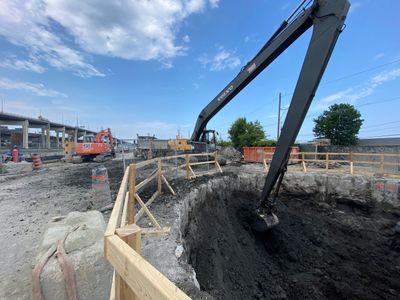

Seaton community’s rapid growth in north Pickering demanded a fast-track sanitary trunk sewer to service housing developments already under construction. To keep pace with active building and closing timelines, the work was delivered at an aggressive pace (24 hours/day, 6 days/week) with the schedule driving every decision.
The program required the construction of 10 deep access shafts, executed using a mix of precast segmental lining, shotcrete, steel liner plate, and cast-in-place liners to suit varying ground and installation constraints. The works advanced through hard till with large boulders, conditions that took a measurable toll on excavation productivity and equipment while maintaining the control required for trenchless sewer installation. The trunk sewer was installed via microtunnelling.
In addition to technical and delivery support, UCI developed approximately $10M in claims on the project—building the entitlement narrative and quantum to support resolution. The contractor successfully recovered payment, helping stabilize the commercial path to completion.
Despite difficult ground and continuous operations, the trunk sewer was delivered just as home sales were closing, providing the critical servicing backbone needed to support ongoing Seaton development.

This deep wet-utilities servicing program delivered approximately 1,500 m of storm and sanitary sewers by microtunnelling through hydrocarbon-contaminated ground under high groundwater conditions.
Eleven watertight access shafts (a mix of secant-pile and precast caisson structures) provided launch/reception points, groundwater cutoff, and controlled handling of impacted spoils, enabling trenchless delivery with minimal surface disruption in a constrained brownfield environment.
A defining challenge on this project was the need for three MTBM rescue efforts under unforeseen circumstances. UCI developed and implemented the rescue methodology, leading the technical planning and execution framework required to recover the machines, return them to service, and preserve line-and-grade while tightly controlling surface disruption.

These interventions protected the integrity of the corridor and maintained alignment continuity in conditions where recovery work can easily cascade into major rework and delay.
Alongside delivery and recovery support, UCI also led the commercial claims effort, preparing over $20M in claims for the project (including structured entitlement support and quantum development), built on a disciplined foundation in technical and project records.

This project was a multi-year municipal wastewater program comprising new sanitary sewers, a pressure forcemain corridor, and modifications to the Bolton Sewage Pumping Station.
UCI was engaged to turn around the distressed project during the contractor’s insolvency, providing crisis-level commercial and technical oversight across multiple work fronts. The program encountered significant pressure-testing non-conformances on the forcemain and major challenges with shaft construction.

The project involved microtunnelling 14 kilometres of 1200 mm concrete sewer and constructing 27 shafts/manholes. The tunnels were built in varying ground conditions, from bedrock to glacial tills and cohesionless soils, including mixed-face conditions.

The tunnelling included curved tunnels, including an unusual reverse curve, and crossings under a major railway and the 401 Highway (the largest highway in Canada, with 14 lanes at the crossing location).